
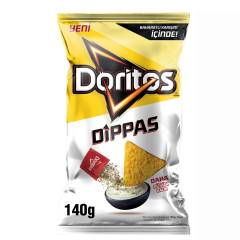
Doritos
Doritos Taco Parti Boy 185 G
Nutrition Score
46 / 100
#47 of 85 in Corn, Tortilla and Nacho Chips
Origin
Türkiye
- Natural, unprocessed food1Natural, unprocessed food
- Basic food ingredient9Basic food ingredient
- Additive or processed ingredient10Additive or processed ingredient
- Ingredient that needs attention1Ingredient that needs attention
- Origin: Türkiye
Besin AI summary
A plain-language summary of this product's ingredients is available in Besin App.
Nutrition facts
Per 100 g- Energy
- 497 kcal / 2,078 kJ
- Fat
- 26 g
- Saturated fat
- 2 g
- Carbohydrate
- 58 g
- Sugars
- 2 g
- Fibre
- 4 g
- Protein
- 6.9 g
- Salt
- 1.6 g
Ingredients
21 ingredientsMaize
What is this ingredient?
Fresh or minimally processed maize kernels.
Ingredient class: 1
Natural, unprocessed food
Foods as they come from nature, or only washed, dried, frozen or ground. Nothing such as salt, sugar or oil has been added. For example fruit, vegetables, pulses, raw nuts, oats, meat, milk and eggs.
Canola oil
What is this ingredient?
A plant- or animal-based fat.
Ingredient class: 2
Basic food ingredient
Traditional ingredients used in home cooking. They are not made in a laboratory but by pressing, milling, drying, cooking or fermenting. For example salt, sugar, honey, butter, olive oil, flour, vinegar, yeast, yogurt cultures and spices.
Wheat flour
What is this ingredient?
A grain- or flour-based food ingredient.
Ingredient class: 2
Basic food ingredient
Traditional ingredients used in home cooking. They are not made in a laboratory but by pressing, milling, drying, cooking or fermenting. For example salt, sugar, honey, butter, olive oil, flour, vinegar, yeast, yogurt cultures and spices.
Salt
What is this ingredient?
Refined salt.
Ingredient class: 2
Basic food ingredient
Traditional ingredients used in home cooking. They are not made in a laboratory but by pressing, milling, drying, cooking or fermenting. For example salt, sugar, honey, butter, olive oil, flour, vinegar, yeast, yogurt cultures and spices.
Sugar
What is this ingredient?
Refined sucrose used as a sweetener.
Ingredient class: 2
Basic food ingredient
Traditional ingredients used in home cooking. They are not made in a laboratory but by pressing, milling, drying, cooking or fermenting. For example salt, sugar, honey, butter, olive oil, flour, vinegar, yeast, yogurt cultures and spices.
Monosodium glutamate
E621What is this ingredient?
Monosodium glutamate (MSG) is a flavour enhancer that strengthens the savoury, broth-like taste (umami) of food. It is used in crisps, instant soups, stock cubes, sauces and ready meals. It is made by fermenting sugar cane, sugar beet or starch with bacteria. Glutamate also occurs naturally in foods such as tomatoes and cheese. In 2017 the European Food Safety Authority set an acceptable daily intake for glutamates of 30 mg per kilogram of body weight and found that this amount can be exceeded by high consumers in all age groups. It noted that in some groups intake can also exceed the levels at which effects such as headaches and raised blood pressure have been seen in people.
Ingredient class: 5
Ingredient that needs attention
Ingredients that call for attention because of an official assessment or a scientific study. An ingredient needs a concrete reason to be placed here: being classified as a possible carcinogen, being banned in some countries or restricted by food authorities, carrying a mandatory health warning, or being an allergen. Being natural or synthetic does not decide it on its own. For example aspartame, sulphites, nitrites, titanium dioxide, tartrazine, smoke flavourings and partially hydrogenated fats.
Disodium guanylate
E627What is this ingredient?
Disodium guanylate is a flavour enhancer that strengthens the savoury, broth-like taste (umami) of food. It is used in crisps, instant soups, stock cubes and sauces, usually together with monosodium glutamate. It is made by breaking down yeast extract or by fermenting sugar or starch with microorganisms. The European Food Safety Authority is re-evaluating these flavour enhancers and has asked manufacturers for up-to-date safety data. Because they are broken down into uric acid in the body, people with gout or high uric acid levels are advised to consume them with care. We will review this ingredient's group once the evaluation is concluded.
Ingredient class: 4
Additive or processed ingredient
Substances added for a technical purpose such as colour, flavour, sweetness, texture or a longer shelf life. They belong here even when they come from natural sources; this is where E-number additives and all flavourings, natural ones included, go. Being in this group does not mean harmful; it shows that the product is industrially processed. For example citric acid, lecithin, pectin, guar gum, curcumin, beetroot red, potassium sorbate, modified starch and flavourings.
Disodium inosinate
E631What is this ingredient?
Disodium inosinate is a flavour enhancer that strengthens the savoury, broth-like taste (umami) of food. It is used in crisps, instant soups, stock cubes and sauces, usually together with monosodium glutamate. It is made by breaking down yeast extract or by fermenting sugar or starch with microorganisms. The European Food Safety Authority is re-evaluating these flavour enhancers and has asked manufacturers for up-to-date safety data. Because they are broken down into uric acid in the body, people with gout or high uric acid levels are advised to consume them with care. We will review this ingredient's group once the evaluation is concluded.
Ingredient class: 4
Additive or processed ingredient
Substances added for a technical purpose such as colour, flavour, sweetness, texture or a longer shelf life. They belong here even when they come from natural sources; this is where E-number additives and all flavourings, natural ones included, go. Being in this group does not mean harmful; it shows that the product is industrially processed. For example citric acid, lecithin, pectin, guar gum, curcumin, beetroot red, potassium sorbate, modified starch and flavourings.
Paprika powder
What is this ingredient?
Dried and ground paprika pepper.
Ingredient class: 2
Basic food ingredient
Traditional ingredients used in home cooking. They are not made in a laboratory but by pressing, milling, drying, cooking or fermenting. For example salt, sugar, honey, butter, olive oil, flour, vinegar, yeast, yogurt cultures and spices.
Onion Powder
What is this ingredient?
A fruit-, vegetable- or fibre-based ingredient.
Ingredient class: 2
Basic food ingredient
Traditional ingredients used in home cooking. They are not made in a laboratory but by pressing, milling, drying, cooking or fermenting. For example salt, sugar, honey, butter, olive oil, flour, vinegar, yeast, yogurt cultures and spices.
Garlic Powder
What is this ingredient?
Powder made from dried, ground garlic.
Ingredient class: 2
Basic food ingredient
Traditional ingredients used in home cooking. They are not made in a laboratory but by pressing, milling, drying, cooking or fermenting. For example salt, sugar, honey, butter, olive oil, flour, vinegar, yeast, yogurt cultures and spices.
Dextrose
What is this ingredient?
Dextrose is a sugar identical to glucose, obtained by breaking down starch. It is used in bars, chocolate, confectionery, baked goods and sauces as a sweetener, bulking agent and humectant (a substance that keeps food moist). It is usually made by converting maize or wheat starch into glucose with enzymes (a natural substance that brings about a specific change in food) and then crystallising it. It is an energy-giving carbohydrate that can raise blood sugar quickly, so it should be treated like sugar.
Ingredient class: 4
Additive or processed ingredient
Substances added for a technical purpose such as colour, flavour, sweetness, texture or a longer shelf life. They belong here even when they come from natural sources; this is where E-number additives and all flavourings, natural ones included, go. Being in this group does not mean harmful; it shows that the product is industrially processed. For example citric acid, lecithin, pectin, guar gum, curcumin, beetroot red, potassium sorbate, modified starch and flavourings.
Potassium chloride
E508What is this ingredient?
Potassium chloride (E508) is a mineral salt with a salty taste similar to table salt. It is used in crisps, snacks, instant soups and meat products to replace part of the table salt and reduce sodium, and also as a gelling agent and flavour regulator. It is obtained by purifying natural salt deposits and seawater; in large amounts it can leave a slightly bitter taste. It is a source of potassium and is partly used as an alternative to table salt; people with kidney disease and those taking certain blood pressure medicines need to watch their potassium intake.
Ingredient class: 4
Additive or processed ingredient
Substances added for a technical purpose such as colour, flavour, sweetness, texture or a longer shelf life. They belong here even when they come from natural sources; this is where E-number additives and all flavourings, natural ones included, go. Being in this group does not mean harmful; it shows that the product is industrially processed. For example citric acid, lecithin, pectin, guar gum, curcumin, beetroot red, potassium sorbate, modified starch and flavourings.
Flavouring
What is this ingredient?
A flavouring is a preparation added to give food a particular taste and smell. It is used in confectionery, drinks, dairy products, snacks and baked goods. As its type is not stated on the label, it may be of natural or artificial origin; flavourings are made by extraction from plant or animal sources, by fermentation (a natural process using microbes such as yeast or bacteria) or by chemical synthesis. It adds no nutritional value; no adverse effects are known at the amounts used in food.
Ingredient class: 4
Additive or processed ingredient
Substances added for a technical purpose such as colour, flavour, sweetness, texture or a longer shelf life. They belong here even when they come from natural sources; this is where E-number additives and all flavourings, natural ones included, go. Being in this group does not mean harmful; it shows that the product is industrially processed. For example citric acid, lecithin, pectin, guar gum, curcumin, beetroot red, potassium sorbate, modified starch and flavourings.
Show all ingredients (21)
- Read the E330 guide →
Citric acid
E330What is this ingredient?
Citric acid (E330) is an acidity regulator that occurs naturally in lemons and other citrus fruits and gives food a sour taste. It is used in drinks, confectionery, jams and canned foods to balance flavour and extend shelf life. Industrially, it is made by fermenting sugar or starch with a type of mould. No adverse effects are known at the amounts used in food; however, frequently drinking acidic beverages can wear down tooth enamel.
Ingredient class: 4
Additive or processed ingredient
Substances added for a technical purpose such as colour, flavour, sweetness, texture or a longer shelf life. They belong here even when they come from natural sources; this is where E-number additives and all flavourings, natural ones included, go. Being in this group does not mean harmful; it shows that the product is industrially processed. For example citric acid, lecithin, pectin, guar gum, curcumin, beetroot red, potassium sorbate, modified starch and flavourings.
Paprika extract, capsanthin, capsorubin
E160cWhat is this ingredient?
Paprika extract (E160c) is an orange-red colour obtained from red peppers; its colour comes mainly from pigments called capsanthin and capsorubin. It is used in crisps, seasonings, sauces, cured meat products and confectionery to add colour. It is obtained as an oily extract (oleoresin) by extracting dried red peppers with solvents. It adds no nutritional value; no adverse effects are known at the amounts used in food.
Ingredient class: 4
Additive or processed ingredient
Substances added for a technical purpose such as colour, flavour, sweetness, texture or a longer shelf life. They belong here even when they come from natural sources; this is where E-number additives and all flavourings, natural ones included, go. Being in this group does not mean harmful; it shows that the product is industrially processed. For example citric acid, lecithin, pectin, guar gum, curcumin, beetroot red, potassium sorbate, modified starch and flavourings.
Breadcrumbs
What is this ingredient?
Dried and ground bread crumbs.
Ingredient class: 2
Basic food ingredient
Traditional ingredients used in home cooking. They are not made in a laboratory but by pressing, milling, drying, cooking or fermenting. For example salt, sugar, honey, butter, olive oil, flour, vinegar, yeast, yogurt cultures and spices.
Yeast
What is this ingredient?
An ingredient based on microorganisms or cultures.
Ingredient class: 2
Basic food ingredient
Traditional ingredients used in home cooking. They are not made in a laboratory but by pressing, milling, drying, cooking or fermenting. For example salt, sugar, honey, butter, olive oil, flour, vinegar, yeast, yogurt cultures and spices.
Tocopherol-rich extract
E306What is this ingredient?
Tocopherol-rich extract (E306) is a plant-derived antioxidant that is rich in tocopherols, the vitamin E family. It is used in vegetable oils, biscuits, cereal bars, crisps and margarine to delay rancidity. It is obtained by distilling fractions separated during the refining of vegetable oils such as soybean or sunflower oil. As it belongs to the vitamin E family, it carries some vitamin E activity; no adverse effects are known at the amounts used in food.
Ingredient class: 4
Additive or processed ingredient
Substances added for a technical purpose such as colour, flavour, sweetness, texture or a longer shelf life. They belong here even when they come from natural sources; this is where E-number additives and all flavourings, natural ones included, go. Being in this group does not mean harmful; it shows that the product is industrially processed. For example citric acid, lecithin, pectin, guar gum, curcumin, beetroot red, potassium sorbate, modified starch and flavourings.
- Read the E300 guide →
Ascorbic acid
E300What is this ingredient?
Ascorbic acid (E300), also known as vitamin C, is used in food as an antioxidant. It is used in fruit juices, meat products, crisps, dried vegetables and baked goods to prevent changes in colour and flavour, and in dough as a flour treatment agent; it is also added to some products as a source of vitamin C. Industrially, it is made from glucose by fermentation (a natural process using microbes such as yeast or bacteria) and chemical processing. As it is vitamin C, it is a source of the vitamin; no adverse effects are known at the amounts used in food.
Ingredient class: 4
Additive or processed ingredient
Substances added for a technical purpose such as colour, flavour, sweetness, texture or a longer shelf life. They belong here even when they come from natural sources; this is where E-number additives and all flavourings, natural ones included, go. Being in this group does not mean harmful; it shows that the product is industrially processed. For example citric acid, lecithin, pectin, guar gum, curcumin, beetroot red, potassium sorbate, modified starch and flavourings.
Extracts of rosemary
E392What is this ingredient?
Rosemary extract (E392) is an antioxidant obtained from rosemary leaves that slows down fats going off and turning rancid. It is used in crisps, frying oils, meat products and sauces to extend shelf life. It is made by extracting dried rosemary with solvents and removing most of its flavour compounds, so it does not give food a noticeable rosemary taste. It adds no nutritional value; no adverse effects are known at the amounts used in food.
Ingredient class: 4
Additive or processed ingredient
Substances added for a technical purpose such as colour, flavour, sweetness, texture or a longer shelf life. They belong here even when they come from natural sources; this is where E-number additives and all flavourings, natural ones included, go. Being in this group does not mean harmful; it shows that the product is industrially processed. For example citric acid, lecithin, pectin, guar gum, curcumin, beetroot red, potassium sorbate, modified starch and flavourings.
Higher-scoring products in Corn, Tortilla and Nacho Chips
Information is compiled from the product packaging. If you spot a mistake, let us know. How is the Nutrition Score calculated?